
Vinyl composition tile
Through-pattern / composition tile
- Commonly full-spread adhered
- Often lower first material cost
- Structured polish & maintenance program
VCT vs LVT is not simply “cheap tile versus premium tile.” VCT often starts with a lower material cost and a familiar, structured floor-finish program. LVT offers a broader visual range and many commercial products reduce or eliminate the traditional VCT polish cycle. The right choice depends on the room, maintenance staff, substrate, traffic, replacement plan and product-specific requirements.
VCT remains a rational commercial choice when the project is budget-sensitive, the owner already operates a VCT cleaning/finish program, and simple modular color or pattern is acceptable.
LVT is often the better starting point when the space is design-led, wood/stone/abstract visuals matter, or the facility wants to reduce dependence on traditional strip-and-polish maintenance.
Neither category overrides the selected manufacturer’s requirements for slab moisture, floor flatness, adhesive, rolling/static loads, cleaning, finish, warranty or installation conditions.
The strongest ranking pages consistently focus on the same themes: material construction, upfront cost, aesthetics, maintenance and long-term value. The table below keeps those useful comparison points while avoiding category-wide promises that only apply to specific products.
| Decision factor | VCT | LVT |
|---|---|---|
| Construction | Composition tile made with vinyl binder, limestone/fillers and pigments; many products use through-pattern or through-color construction. | Layered resilient construction with a visual layer and protective wear surface; exact construction varies by product. |
| First material cost | Often lower, which can matter on large budget-driven projects. | Often higher, but the comparison should include maintenance and downtime rather than material price alone. |
| Maintenance | Traditional commercial programs commonly include initial polish plus routine cleaning, periodic scrub/recoat work and restorative stripping/refinishing as needed. | Many commercial products use factory-applied wear surfaces/topcoats and do not follow the traditional VCT finish cycle. Manufacturer instructions still control. |
| Design range | Strong modular color/pattern capability; typically a simpler visual language. | Broader wood, stone, concrete and abstract visuals with tile and plank formats. |
| Installation | Commercial VCT is commonly full-spread adhered and depends on proper substrate preparation. | Commercial LVT may be glue-down, loose-lay or other approved formats. Compare the actual installation system, not the acronym alone. |
| Repair / renewal | Individual tiles can often be replaced; finish systems can also be renewed when the product and condition allow. | Individual tiles/planks can often be replaced in glue-down installations; replacement method depends on construction and adhesive. |
| Moisture | Both require substrate-moisture evaluation and compatible adhesives/installation systems. Do not treat either category as a guarantee of a waterproof installed floor assembly. | |
| Rolling & static loads | Use the selected product’s current technical data. Load performance cannot be assigned reliably from “VCT” or “LVT” alone. | |
The top-ranking comparisons are right to emphasize maintenance, but “VCT is expensive to maintain” is too simplistic. VCT is built around a defined maintenance system. Manufacturer guidance commonly includes an initial polish/finish step, routine cleaning, periodic scrub-and-recoat work, and restorative stripping/refinishing when the finish has reached the point where normal maintenance is no longer enough.
For a facility that already owns the equipment, trains staff for that process and schedules the work routinely, the predictability can be an advantage. For an owner trying to reduce chemical, labor or closure cycles, many commercial LVT products are attractive because the factory wear surface changes the maintenance plan.
The correct lifecycle comparison is therefore not “wax versus mop.” It is the facility’s real maintenance program versus the selected product’s real maintenance program.
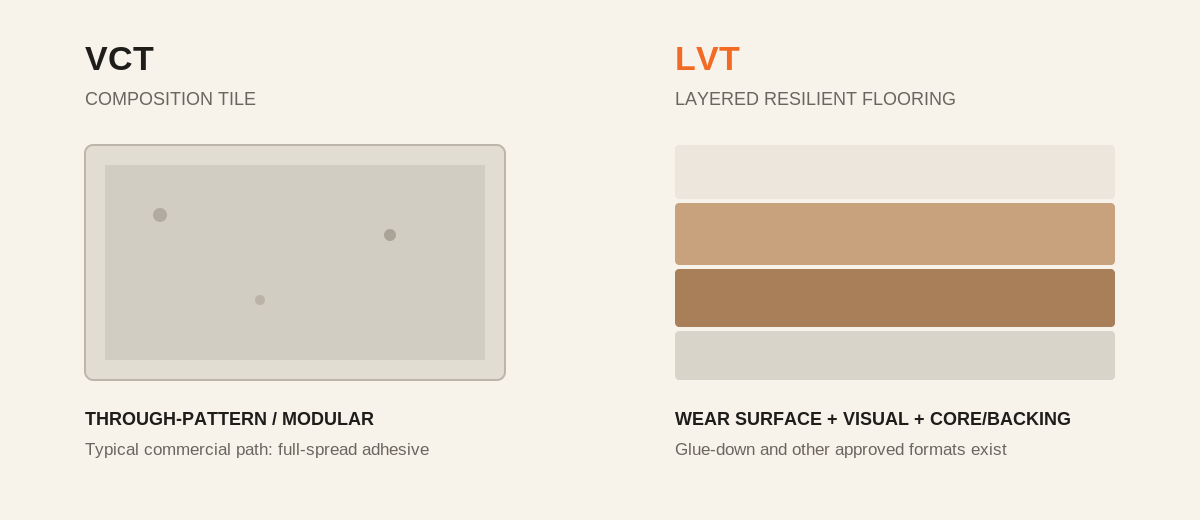
One weakness in many VCT vs LVT comparisons is that “LVT” gets treated as one construction. In practice, LVT can include glue-down flexible tile/plank, thicker loose-lay formats and rigid-core click systems. Those products can differ substantially in thickness, floor preparation, transition height, repair method, indentation behavior and installation speed.
For a true apples-to-apples commercial comparison against VCT, glue-down LVT is often the most relevant benchmark because both systems are bonded to the substrate. If a floating rigid-core product is also being considered, compare the installation system separately.
Manufacturer and RFCI resources continue to position VCT as a durable commercial/institutional floor. Its value case is strongest when the owner understands the maintenance system rather than discovering it after installation.
When material budget is the dominant constraint, VCT can keep the initial flooring package simple without pretending future maintenance is free.
Schools, institutional portfolios and other facilities may already own equipment, train staff and schedule finish cycles around VCT.
VCT can create strong graphic floors with repeatable colors, borders and wayfinding patterns without needing a wood- or stone-look surface.
Tile replacement and restorative finish work can be useful when the facility values renewal over full-floor replacement.
Shaw Contract’s ranking page focuses on education and healthcare and highlights the same factors that drive many commercial LVT decisions: broader design choices, factory-applied wear surfaces and less dependence on a traditional polish cycle. Those are useful signals, but the specific performance numbers on that page belong to Shaw’s products—not to all LVT.
Wood, stone, concrete and abstract visuals give designers more control over brand, hospitality and customer-facing environments.
Many commercial LVT products rely on their factory wear surface rather than a traditional VCT polish system, simplifying one part of the maintenance plan.
Tile and plank sizes, glue-down and other constructions create more ways to fit the floor to the space and installation strategy.
LVT gives project teams more ways to choose visuals and constructions by area instead of forcing one floor across the entire building.
These are starting points, not universal specifications. The final decision should come from the room requirements and the selected product documents.
VCT: strong first-cost logic when the district already operates a finish program.
LVT: attractive when design and reduced finish-cycle work justify the material premium.
LVT is often considered for visual and maintenance reasons, but healthcare projects may require sheet resilient, rubber or other specialized systems depending on room conditions.
LVT often leads when the flooring is part of the brand experience. VCT remains viable where budget and an established maintenance program outweigh visual realism.
VCT can remain a practical value choice. Confirm chemicals, rolling loads, moisture, cleaning methods and floor-finish requirements before specifying.
Do not assume replacement is automatically required. Evaluate the condition of the existing floor, restoration options, removal requirements and the manufacturer-approved substrate path for any new floor.
Standardize more than color. Compare product availability, maintenance training, repair stock, installation system and the ability to repeat the specification across locations.
The old CFS version of this guide used generic square-foot price ranges and a universal ten-year ownership conclusion. That creates false precision. A better commercial comparison uses actual project inputs.
Ask bidders to separate material, floor preparation, adhesive, installation labor, initial finish, routine maintenance assumptions, restorative maintenance, downtime and replacement strategy. Then compare both floors over the same ownership period.
If the facility already has a VCT program, use its actual labor and chemical history. If the project is considering LVT, use the selected manufacturer’s maintenance instructions rather than assuming every LVT is “mop only.”
CFS currently treats VCT as a project-sourced category. Glue-down LVT availability should also be confirmed against the active catalog and supplier program rather than assumed from a generic comparison page.