
Commercial LVT / Resilient Plank
Can be considered for resident rooms, corridors and selected common areas where a commercial resilient product fits the rolling traffic, cleaning plan and substrate.
Review commercial LVP / LVT →Nursing home flooring sits closer to the clinical side of senior living. Resident mobility, rolling equipment, rehabilitation activity, cleaning, spills and occupied-facility work all affect the floor. CFS helps project teams organize those requirements by care area, compare appropriate material paths and price stocked and project-sourced systems without turning the page into another generic senior-living product catalog.
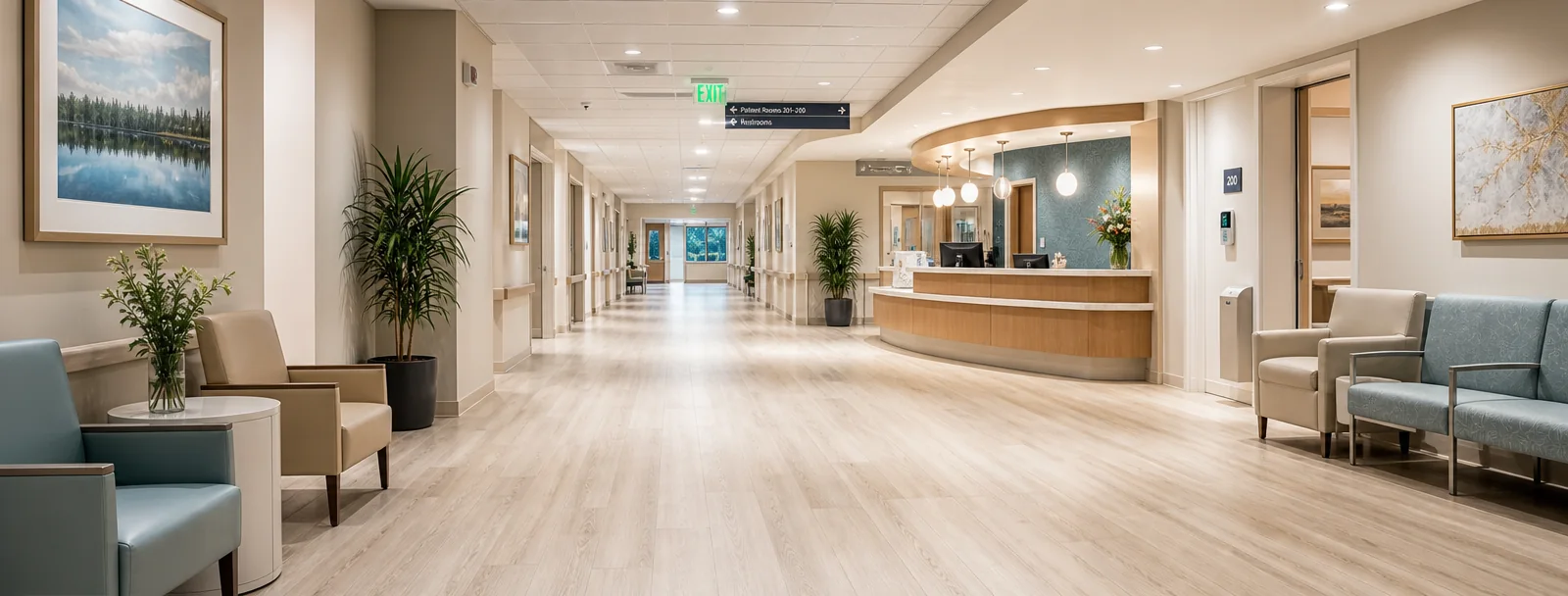
Residents may use walkers, wheelchairs or staff-assisted transfers throughout the same corridor. Flooring should be reviewed together with transitions, thresholds, changes in material and the way mobility devices move across the surface. Visual design matters, but the finished route should not create unnecessary confusion or abrupt changes simply to make the floor more dramatic.
Resident rooms and ordinary corridors can have different cleaning and liquid-control needs from bathrooms, treatment-support spaces or other higher-control environments. Plank and tile resilient flooring still have joints. Where the project requires welded seams, integral base details or a more tightly controlled surface, sheet resilient or another specialty system may be the correct path.
Noise from carts, footsteps and activity can affect the resident experience. Carpet tile, rubber and selected resilient systems can contribute differently to room acoustics and floor-to-floor sound. For upper floors, evaluate the complete tested floor-ceiling assembly rather than assuming an attached pad or product-only number proves the project requirement.
Long corridors and care areas see turning loads and rolling equipment that a normal residential room does not. The installation system, substrate, adhesive where applicable and manufacturer requirements all matter. Local repair strategy also matters in a facility that cannot casually close a wing every time a floor is damaged.
Nursing homes and skilled nursing facilities commonly remain operational during renovation. Work may need to move room by room, corridor by corridor or wing by wing while maintaining resident access, staff routes and daily care. Material availability, staging, furniture movement, debris control, odor expectations and return-to-service timing belong in the plan before the final order is released.
The ranking pages consistently discuss multiple materials rather than one universal nursing-home floor. CFS should do the same: describe where each system may fit, then let the care-area requirements and project documents determine the final choice.
Can be considered for resident rooms, corridors and selected common areas where a commercial resilient product fits the rolling traffic, cleaning plan and substrate.
Review commercial LVP / LVT →May be appropriate where the project calls for fewer seams, welded joints, integral base details or a more tightly controlled surface than plank flooring provides.
Request project-sourced options →Can be evaluated in rehabilitation, corridor or other areas where comfort, traction, acoustics or rolling performance are important to the facility.
Review rubber flooring →Can support quieter, more residential lounges or selected resident-facing areas when the maintenance program and care model make textile flooring practical.
Review carpet tile →The two markets overlap, but the search intent is not identical. Our assisted-living page focuses more on residential character, community spaces, portfolio purchasing and balancing hospitality-like living with operations. This page focuses on skilled nursing flooring: care-area differences, rehabilitation activity, mobility devices, rolling medical equipment, liquid and seam strategy, and occupied clinical operations.
That distinction is also reflected in how major manufacturers organize senior living. Tarkett separates Assisted Living from Skilled Nursing / LTACH and provides different care-area guidance within each. CFS should preserve that difference rather than creating two near-duplicate SEO pages.
Planning an assisted living community instead? Review Assisted Living Flooring →A skilled-nursing renovation may include more than one flooring category. CFS can price appropriate stocked products directly and review sheet resilient, rubber, carpet tile or other project-sourced systems in the same request. That allows the buyer to compare the real material and sourcing path by care area instead of forcing every room through one specification.
Separate resident rooms, corridors, rehabilitation, dining/common areas and higher-control spaces before choosing products.
Confirm existing floor, preparation, moisture, floor level, transitions and installation method.
Evaluate physical samples in the facility and collect the manufacturer documents required by the project.
Coordinate access, furniture, staging, resident routes, cleanup and return-to-service requirements.
Confirm current availability, quantity, destination and freight for each phase before the order is committed.
For final specifications, use the selected manufacturer’s current product documents, installation instructions and the requirements of the facility and project team. CFS can help organize applicable documentation for stocked and project-sourced flooring.